Showing posts with label home schooling. Show all posts

Sunday, May 10, 2015

Experience Matters!

The other night we camped near an RV that had this saying on it:


Life is a book and those who do not travel


Through our travels, we – and our children – are having the opportunity to read lots of pages. It’s all about experiences. Here are a few we’ve had in the past month:


Building a Tree Fort at Earthen Heart Farm

playing on the beach at lake michigan 

visiting chicago

learning from a microbiologist

geocaching at the great plains zoo

playing in the snow during a blizzard in hill city, sd

My kids have spent time in rural areas, small towns and big cities. They have met people from all over the country and are building a wide range of background knowledge and will serve them well later in life. Already they find connections between our travels and the books they read, the shows they watch and the content they study. This cements those ideas and facts into their brains better than any lecture I could give.

The best part? This is just the beginning. We’ve only been traveling full time since January and already we have experienced so much. I am so appreciative of this time with my family and am looking forward to the journeys to come.

signature

Monday, April 13, 2015

Preschool Homeschool Cards

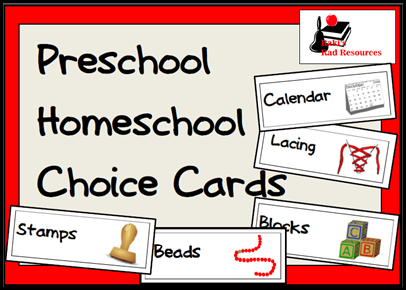
Choice cards saved the day for my preschooler. Free download from Raki's Rad Resources.

My youngest son has only just turned four. We decided early on that he didn’t need to do any sort of “curriculum” for awhile. Instead, we would let him follow his interests and we would spend a lot of time talking to him about what was going on, which brings in colors, letters, shapes, vocabulary etc. This also allows us time to label items in English, French and Arabic for him and expose him to quality t.v. shows and iPad apps in all three of his languages. However, he has been very jealous of the fact that his brothers have “homework”. It gave them the “privilege” of mom’s attention, first dibs on technology, etc. etc. So to help the situation – and to stop the constant question of “What can I do mom?”, I created these “homework” cards for him.

Choice cards saved the day for my preschooler. Free download from Raki's Rad Resources.

We printed them, laminated them, put magnet tape on the back and hung them on the refrigerator. As the day goes on, if he starts acting bored, I ask him to “pick a card”. He chooses what he wants to do using the picture clues and moves it to the right hand side of the fridge. Then he does his activity. Sometimes he lasts 5 minutes at the activity. Other times he lasts 50 minutes. He has no time limits, but is required to clean up one activity before he can pick another card.

Choice cards saved the day for my preschooler. Free download from Raki's Rad Resources.

The difference in his behavior since we started this has been phenomenal! He is now rarely jealous of his brothers’ homework, because he has his own. He spends a lot less time wandering around annoying those people who are trying to work, which makes life so much easier for all of us. And he is much more willing to do things he might not usually want to do, like calendar, simply because he chose it and it wasn’t Mommy saying “Let’s do this now.”

Choice cards saved the day for my preschooler. Free download from Raki's Rad Resources.

If you’re interested in using these choice cards with your children, feel free to grab them from my Teachers Pay Teachers store. They are a free download.

signature

Tuesday, March 17, 2015

Living in a Field Trip

We spent three months on Thus Far Farm, living a field trip with our kids.  RVing with the Rakis.

The other day my son told me, “Hey mom, you know living at the farm is like being on a field trip all the time!” 

In a lot of ways, he’s right.  My boys have seen things and learned about topics often only introduced on field trips.  For example:

They can tell you the history behind this shoe:

We spent three months on Thus Far Farm, living a field trip with our kids.  RVing with the Rakis.


They know how to use these to preserve food:

We spent three months on Thus Far Farm, living a field trip with our kids.  RVing with the Rakis.


They gather eggs from chickens and pet the turkeys:

We spent three months on Thus Far Farm, living a field trip with our kids.  RVing with the Rakis.


They have learned about starting plants from seeds, fertilizing and weeding:

We spent three months on Thus Far Farm, living a field trip with our kids.  RVing with the Rakis.


They eat dinner twice a week surrounded by butter churns and cast iron skillets:

We spent three months on Thus Far Farm, living a field trip with our kids.  RVing with the Rakis.


They have wandered through these woods, playing in the creek, looking at plants and searching for bugs:

We spent three months on Thus Far Farm, living a field trip with our kids.  RVing with the Rakis.


They have learned what to do if the cows charge at them:

We spent three months on Thus Far Farm, living a field trip with our kids.  RVing with the Rakis.


They have learned how to chop and carry wood for the fireplace:

We spent three months on Thus Far Farm, living a field trip with our kids.  RVing with the Rakis.


All of these are lessons often taught only during field trips with school or scouts.  Instead of waiting for a special occasion, my kids have had the opportunity to live here, explore, and talk with experts every day.  We are so blessed that the owners of Thus Far Farm, Mary and Bill, have not only given our children the opportunity to explore, but they have been ready and willing to explain and answer questions.  Living a field trip is one of the best things I’ve ever done for my kids!

signature


Thursday, March 12, 2015

Homeschooling in Three Languages

When I tell people that we homeschool in three languages, I generally get two questions – Why? and How?


How and why we choose to homeschool in 3 languages - Arabic, French and English - From Heidi Raki of RVing with the Rakis.


Let’s start with why?  For three years, we lived in Morocco, where my husband is originally from.  While we were there, the older two boys attended school in French and Arabic.  When we arrived they were 3 and 7 and spoke very, very little of either language. We dropped them into a Moroccan school and they learned by emersion. By the time we left Morocco three years later, they were 7 and 10 and could understand, speak, read and write both languages on grade level.  Although we were ready to leave Morocco, we weren’t ready for them to stop learning these languages, which was a major reason we chose to homeschool.  We wanted them to have time for all of their languages, rather than have them do additional homework after a full school day and begin to resent the languages, or worse simply forget them.


Now, how?  How do you learn in three languages?  Pretty much the same way you learn in one.  Our home language has always been English, so that continues to be the language we start explaining a topic in.  This is the reason that we are working on our Science and Social Studies through our Year Long Country Study in English.  However, every week the boys work on reading, writing, grammar, and math in all three of their languages.  We have played with a variety of formats and found that we most like doing one subject at a time in all three languages, giving the boys a chance to make connections between all three of their languages. 


For example, on Friday we work on Grammar and the kids have learned things like a verb is a verb in any languages, but that the verbs simply conjugate differently depending on the language.  Monday is Math day.The boys work on Math in English, French and Arabic.  They tend to learn the concepts in English, but work in the textbooks that we brought back with us from Morocco and on websites that my husband has found, to explore the same concepts in French and Arabic.  This gives them time to work on the vocabulary and the word problems in all of their languages, and further cement their knowledge.  Additionally, some problems – especially Long Subtraction and Long Division are presented differently in different countries and this is reflected in their textbooks.  (I have made a resource to help explain the different ways you can do Extended Operations, which you can download for free from my TeachersPayTeachers store.)


In addition to general curriculum in French and Arabic, the boys work on French in DuoLingo and Arabic using a variety of iPad apps to keep building their vocabulary.  Overall, we spend a lot of time comparing and contrasting and thinking deeply about the topics at hand.  Three languages can make for a full day, but the benefits our kids are getting are undeniable and the more connections they make the longer they remember things.  This situation is definitely best for our family right now.


signature

Tuesday, January 6, 2015

Lessons Learned from Trimester One

We have broken down our school year into three trimesters.  Each of trimester lasts three months and after each trimester we take a month off.  So, our first trimester consisted of September, October and November and then we took the month of December off – at least off of book work, we still did lots of “unschooling” activities.  Now that we have completed our first trimester, I am reflecting on what worked and what didn’t and making adjustments to our routine accordingly.


Lessons Learned from Trimester 1 of our Roadschooling Adventure.  RVing with the Rakis


Here are some of the things that worked:

1.)  Letting the boys choose their own individual order for completing their work.  My oldest prefers to work by language – completing all the French at once, all the Arabic on another day, etc. My middle son prefers to work by subject – completing all the Math on one day and all the Grammar on another.  By letting them have control, they were much more likely to manage themselves and they were much less needy during the day.


2.)  Listening videos.  I started an activity that I simply call “listening” where the boys listen to educational videos – on topics of their own choosing.  They listen to two 20 minute videos in each language (Arabic, French and English) a week and then summarize what they watched.  I started this mainly so that they would continue to be “immersed” into Arabic and French.  Lo and behold they LOVE this activity, especially in English!  They choose crazy different topics and are big fans of TED Ed videos and have built up tons of background knowledge that they can in turn use to make connections with their reading, content and other learning.


3.) Calendar and map skills.  We have a desk calendar and a world map posted in the hallway.  Officially the calendar is for the 3 year old and the map is for the big boys.  However, everyone has benefited from both of these being posted.  Sam works on calendar every day, going over the days of the week, counting to 31, counting by 10’s, working on patterns and recording the weather – all in English, French and Arabic.  Sometimes he does this with me, but often he works on it with one of his brothers. It has been a great review for the 2nd grader and a great chance for responsibility for the 5th grader.  The map was posted to help the older boys, but has made my 3 year old EXTREMELY interested in maps and especially where everyone he knows is “on the map.”  One of our projects for this trimester is to post pictures of family members and friends near where they live.     


4.)  Minecraft carrots.  Completing work in an appropriate amount of time was an extreme challenge for my 7 year old at the beginning of trimester 1.  As with most kids, he has a carrot and his is Minecraft.  So our deal is that I say how long something “should take” – often padded with 5 or 10 minutes and if he completes the work in that designated time, he gets to go play Minecraft for 10 minutes before returning to his school work.  This gives him a good brain break and has proven to be a highly effective motivation for material he isn’t interested in at the moment.


5.)  Visual checklists posted at the beginning of the week.  On Monday, the kids receive a list of EVERYTHING that they will do for the entire week.  Then, as we finish things, they cross items off of the list.  This helps them visualize exactly how much they have completed and how much they have left.  They also plan their weeks, often with the goal of having half or all of Friday free, based on these checklists.


Our Weekly To Do List for our Roadschool - homeschool - lessons.  The children receive lessons in English, French and Arabic.  RVing with the Rakis.


Here is some of what DIDN’T work:


1.)  Having Mom plan and monitor Arabic and French.  The only reason we had me in charge of this was that the Mister was working on his student teaching and he didn’t need another bit of work.  However, I am very glad to hand it over to him this trimester, as my Arabic and French are not quite up to snuff!


2.)  Working straight through the day.  We were working a “standard school day” and by the end of the day, the boys were exhausted!  The only time the Mister had to work with them was in the evenings and by that time they were too tired to really focus.  This trimester, we are trying something new.  We are working half of the day – from 8 until 12:30ish.  Then, the boys take a long break to run around, play games, watch movies, etc.  When the Mister gets done with whatever his workamping duties are, (We’re on a farm right now, so he’s been splitting logs and helping with the chickens.) we pick up again for another two hours.  The morning hours can be used for whatever language needs working on,but the afternoon/evening hours are exclusively for Arabic and French.  This gives the boys focused time with these languages when their dad is around to help them.


3.)  Too many book assignments.  Because we are trying to keep them “up to snuff” in three different languages, it is really easy just to assign them a ton of textbook pages.  However, we didn’t start homeschooling to exclusively work out of a workbook.  So, this trimester, our to do list specifically asks them to free write or journal in each of their languages, to play math games and to complete language puzzles.  It gives them a few more choices each week that are not textbooks.


4.)  I forgot to do mini lessons!  I didn’t really forget, we were doing mini lessons as needed, but always after they had difficulty with a problem or textbook page.  This trimester we are starting each day out on the whiteboards, working on a specific skill that I know they’ll need during that week’s work.  This will help build up skills ahead of time, making for less issues with textbook pages – I hope.


5.)  I got caught up in what we HAD to do and forgot I was in control.  As a school teacher, there is so little you’re in control of.  You have a curriculum, you have to cover it all – end of story.  This was my mentality during Trimester 1 and I was stressed about getting it all in.  Then it finally occurred to me over our break – I wrote the curriculum!  I pieced together what was necessary from each language and subject.  If there was too much, all I needed to do was take some out.  Obviously, I can’t remove everything, but the boys are both reading more than a grade level ahead in English and are at least a grade level ahead in Math in all of their languages.  They are learning grammar, vocabulary, comprehension, writing, and math in three languages.  They’re good.  Remove the stress and truck on!


So, with all of these insights, we move into Trimester 2 and are actually more excited about the non-curriculum opportunities that lie ahead of us this trimester, including an opportunity to learn to classify trees and plants, an opportunity to explore the world with our new digital microscope and the opportunity to start corresponding with our new pen pals!


signature

Saturday, October 25, 2014

Where are the Homeschooling Materials?

As a classroom teacher, I always had so much “stuff” that I “needed” to teach.  So, when we decided we were going to home school our children while living in an RV, I had to re-look at what I really “needed” to teach – and then I had to figure out where to put it!


First, what did I absolutely need?  Books!  Although we got rid of a few English books, we kept the majority of our kids’ English books and purchased additional French and Arabic kids’ books so that the kids would have a lot of options for quality reading materials – both fiction and non-fiction.  Additionally, we purchased a Kindle Fire for our 2nd grader (the 5th grader already had one), so that he would have additional e-book options. 


We store pleasure reading books under one side of the dinette and in the three drawers in the boys’ room. 

Homeschool organization while living in an RV - RVing with the Rakis


Homeschool organization while living in an RV - RVing with the Raki

Since we are homeschooling not only in English, but also in French & Arabic – languages that I am not a native speaker in, I felt it was very important to have curriculum books for this work.  This helps me make sure I cover all of the right grammar rules and keep the kids practicing skills like reading the directions and using important vocabulary. (In English, the kids mainly use materials that I make and sell in my Teachers Pay Teachers store.)  We keep these curriculum books in the boys’ “locker”, where they each have a shelf with their notebooks and textbooks.

Homeschool organization while living in an RV - RVing with the Raki

Additionally, the boys have these white paper organizer totes that I picked up cheap at Target.  My husband screwed these down to their table and the boys keep their current pleasure reading books, their kindles, cameras, and headphones (as well as other random “kid stuff”) in these white totes.  After books, the next most important homeschooling supplies are office and art supplies like crayons, paint, scissors, pencils, etc.  We keep these supplies organized in ziploc bags, which fit nicely into this single drawer.  The drawer fits on the boys’ table in between their white book totes, and also provides them with a place to hold library books!


Homeschool organization while living in an RV - RVing with the Raki


Rather than having a lot of manipulatives, we tend to use toys and games to help illustrate math concepts, and to allow our 3 year old to play with different concepts like taller and shorter or how many blocks long is that?  We also use a bunch of food supplies for math manipulatives – for ideas about this check out my blog post: Math Manipulatives from Your Kitchen

We keep the toys – wooden blocks, legos, soldiers, cars and marbles – in milk crates underneath our desk/table. 

Homeschool organization while living in an RV - RVing with the Raki


We keep puzzles and games – pattern blocks, scrabble, perfection, and a variety of board games – underneath the other side of the dinette.


Homeschool organization while living in an RV - RVing with the Raki

The last element of our home school supplies is technology.  As I already said, each of the big boys has their own kindle, which helps with reading, online research, watching their “listening videos” and the creation of some projects.  For projects that require a PC, the boys share a laptop (and sometimes use mine). 


Two random pieces of our organization process are: the boys laminated to-do lists, which hang on a bulletin board in their room, and the two kitchen timers that we use to set time limits on work – and play – time.

Homeschool organization while living in an RV - RVing with the Raki

We are now officially finished with our first two months of homeschooling, and have really found the “swing of things”.  We have changed our organization over the past two months, putting the items that get used regularly in more accessible places.  Having these items organized makes the day go smoother and leads to more learning!  For more information about our home school schedule and our home school curriculum, check out this post from the beginning of the school year.

signature